

When you buy a welded mesh through an online store, you are buying a pig in a poke .
After all, they require an advance payment for the grid. You paid for a welded mesh with a cell of 50.8 mm and a wire of 2 mm, and a mesh with a cell of 50.8 mm and a wire diameter of 1.8 mm came to you.
For many mesh suppliers, this large wire diameter tolerance is normal.
If you buy a chain-link mesh , then you will also "get" on the size of the cell.
Instead of 50mm, you will get 60mm. As a result, you can buy the cheapest mesh and overpay for it, while 30% more than its real value.
To prevent this from happening, control what they sell to you on the Internet .
Step 1.
Ask to send a photo with a higher resolution along with a ruler of the exact grid that will be supplied to you.
The ruler should be in the same plane with the mesh canvas. If you put a ruler under the grid, then the diameter of the wire will seem to you larger than it really is.
Step 2
Upload the resulting photo to Photoshop. In our case, this is a welded mesh 25.4x12 with 1.2 mm wire

Step 3
Using the "ruler" tool, measure the length of several centimeters of the ruler (let's call the number of measured millimeters "a"). The program indicates the desired size at the top right. The more measured millimeters, the more accurate the further measurements. Take measurements along the divisions of the ruler so that you can see how many millimeters you are measuring. You get the number "b". In our case, a = 110 mm, b = 65.34
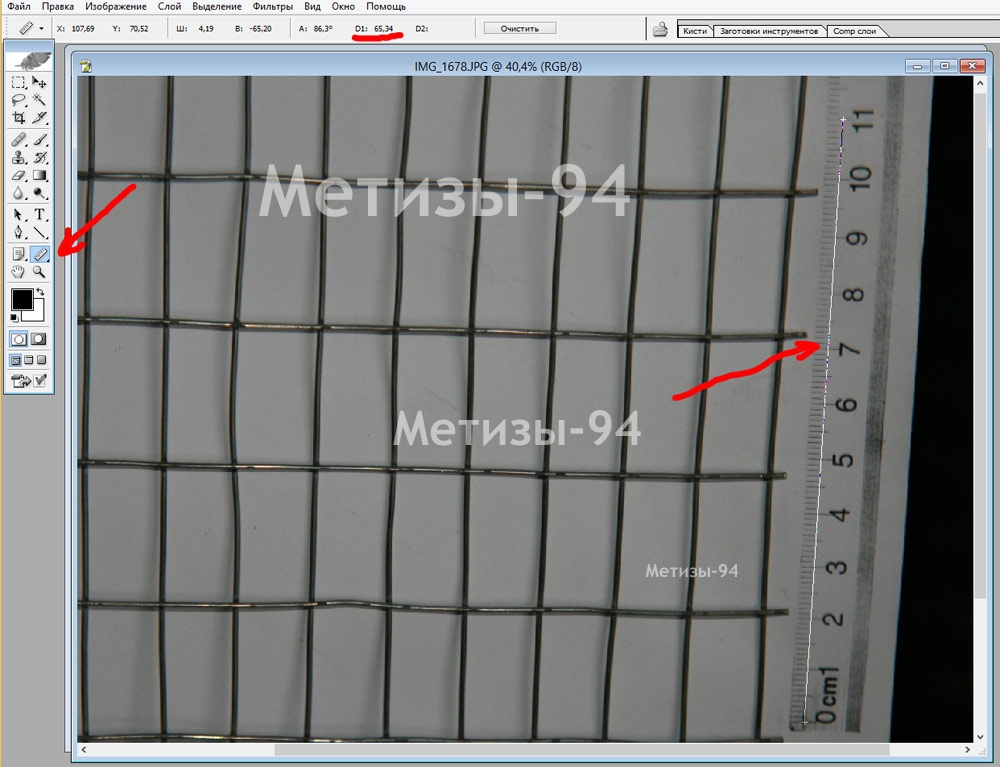
Step 4
Measure the diameter of the wire. You get the number "b".
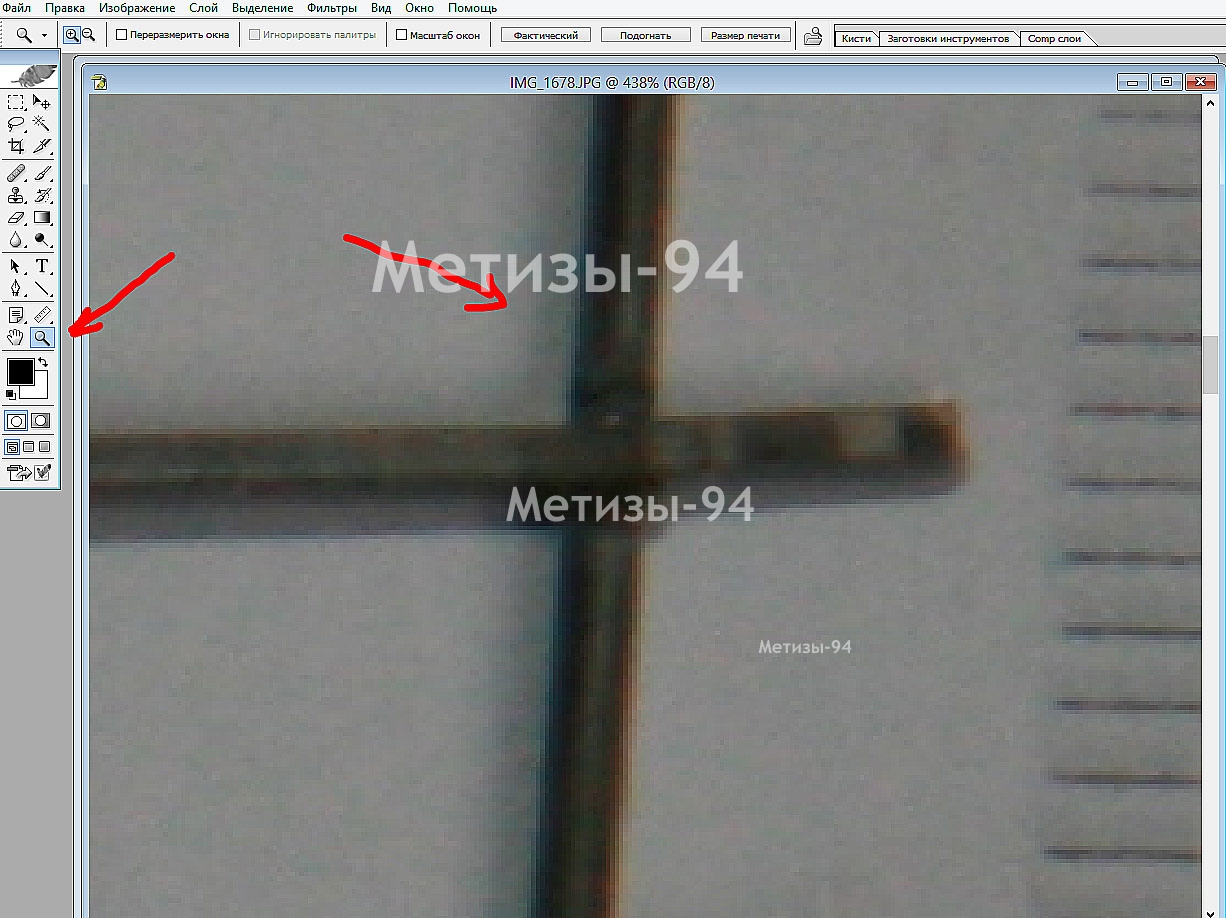
In our case, b=0.69

Step 5
Calculate wire diameter "d": d=c/b*a
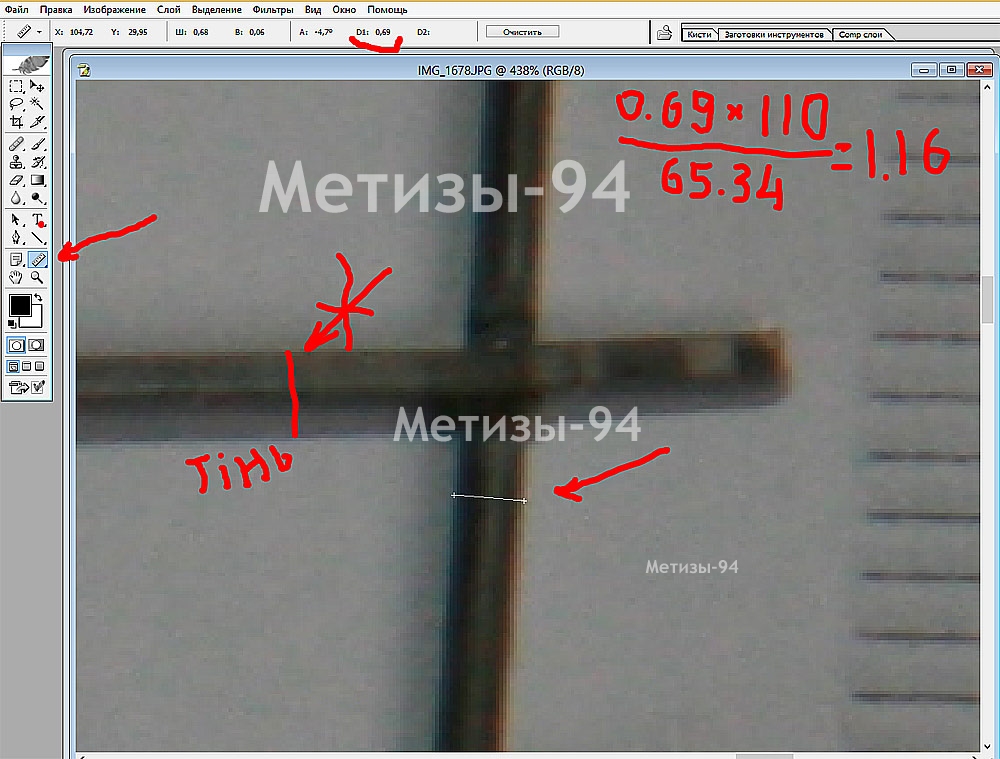
With a high resolution photo, you can calculate the wire diameter to the nearest hundredth .
In the case of our grid d=0.69/65.34*110=1.16
This measurement shows that the Chinese grid 25.4x12.7x1.2 has a very high compliance with the declared dimensions. The wire tolerance is less than -0.05 mm.
Don't try to find a grid with plus tolerances. They don't exist.
The entire mesh is produced with minus tolerances for the wire diameter and with plus tolerances for the mesh size .
With very small tolerances, for example -0.01, do not look either. The tolerance on the wire is -0.05 mm due to the technological features of its production.
Using the same method, you can check the actual size of the mesh cell, the sizes of other types of mesh, wire and other goods in which it is necessary to control the size.